

The mini-split system – the residential stalwart – versus the commercially-developed PTAC technology…
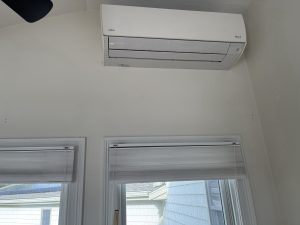
In one corner: The electric mini split is the established contender in the residential market for heating a room or small area. Its technology is so energy efficient that the Commonwealth of Massachusetts (through Mass Save) actually offers rebates to homeowners who install a mini split HVAC (Heating, Ventilation and Cooling System) system.
Relatively compact, the mini split gets mounted to a wall, typically high up. The mini split also requires a connection to an outdoor condenser. (Up to 5 mini splits can connect to one condenser. However, your installer will need to run lines along the outside walls of an existing home to the condenser for each mini split. If multiple mini splits are required, a homeowner might want to consider, instead, an energy-efficient electric ducted heat pump, as long as the ductwork can easily be run from the HVAC unit – usually located in a basement or attic – to multiple rooms containing HVAC vents.)
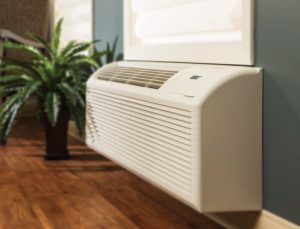
In the other corner: You will often find the commercially-derived PTAC (Packaged Terminal Air Conditioner) in hotel rooms. PTACs are self-contained, ductless heating and cooling units that are individually zoned. Its advantage: A PTAC’s up-front cost is lower than a mini-split and does not require connection to an outdoor condenser. Unlike traditional centralized HVAC systems that fire air into ducts to each room of your home, a PTAC unit contains all components for heating, cooling and ventilating a single room or area. Like mini-spits, PTACs offer customized temperature control for the room or area they serve.
Is a PTAC the up-and-comer for residential homes? While a PTAC is considerably less expensive to purchase and install, it does require much more electrical current to run, adding to its cost over time. A PTAC also requires a dedicated 230-volt circuit at 15 to 20 amps. A comparable mini split might draw half that. This makes PTACs less attractive for homeowners concerned with operating costs, argue detractors of residential PTACs.
A typical PTAC system “costs around $3,600, which includes all the necessary components,” says Darrin Mann, head of Mann’s Heating and Air Conditioning in Middleboro. “We installed PTACs at an assisted-living complex,” Mann says. “One or two units are required per dwelling, depending on square footage, typically one in the main living area and one in the bedroom.”
Although noisier than mini splits, the PTACs that I personally experienced on my last two hotel stays seemed no more intrusive than a calming floor fan. Mini-spit installers maintain that PTACs are more visually intrusive, but I found that difference to be negligible.
“PTACs do have the benefit of lower upfront costs, self-contained design, and no refrigeration piping,” explains Jay Stahlberg of Plymouth’s Baystate Energy Services. “But they’re usually more of a quick-fix solution; in the long run, maintenance and replacement costs can outweigh the savings compared to a mini-split system.”
So a tradeoff exists between a PTACs lower initial cost to install versus its higher electrical cost that a homeowner incurs over time. If I, personally, were to install a PTAC in my Plymouth residence, I would hope that my home’s solar panels would absorb much of the additional energy cost (for both my wallet and the environment).
Stahlberg of Baystate Energy Services maintains that PTACs are noisier than mini splits and “less aesthetically pleasing”. He added: “While mini splits are not invisible, they are far quieter and offer better comfort control, zoning, and humidity management.” (You can visit Baystate Energy’s showroom within Plymouth’s waterfront at 10 Water Street.)
Personally, my own small home office sports a Fujitsu mini split, mounted high on the wall. A PTAC would not be a candidate; the self-contained unit could not possibly sit under one of its many windows. Why? The office’s outside wall is occupied by my desk, file cabinets and piles of “junk”. I admit my situation is likely an anomaly.
PTAC units are a staple in hotels, dormitories, and other commercial applications, but have been rarely considered for residential projects. Will that change? “I don’t see PTACs making serious inroads into the residential market,” Stahlberg maintains. “Homeowners generally prioritize efficiency, aesthetics, and comfort – areas where mini-splits clearly win. PTACs remain attractive mainly in commercial applications, where low upfront cost and simple replacement are the priorities.”
Here’s what AI-engine ChatGPT told me on the matter of residential mini splits versus PTACs:
“You’re asking whether PTACs (Packaged Terminal Air Conditioners) will gain significant traction in the residential HVAC market for single-room heating and cooling—especially relative to mini-split systems. Let’s dive into the advantages, limitations, and market trends for both to give you a clearer picture.
PTAC vs Mini-Split: Features and Trade-Offs
PTAC units
Pros:
- Lower upfront cost: PTACs are generally less expensive per unit. Typical prices range from about $800 to $1,500, with installation often being around $300–$700.
- Simple installation: They slide into a wall sleeve; replacement is straightforward.
- Self-contained, minimal maintenance: Easy filter access and fewer components to service.
Cons:
- Lower energy efficiency: Mini splits generally save 30% in energy over PTACs.
- Noisy operation: PTACs tend to be louder, as the compressor and fan are inside the room.
- Aesthetically intrusive: They’re bulky through-wall units and limit placement flexibility.
- Shorter lifespan: Typically 7–10 years, versus 12–20 years for mini-splits.
Mini-Split Systems
Pros:
- High energy efficiency.
- Quiet and comfortable: Indoor units operate quietly; compressor noise is external.
- Flexible and aesthetic: Sleek wall-, ceiling-, and floor-mounted indoor units.
- Zoning capability: Multi-zone functionality for multiple rooms from a single outdoor unit.
- Longer service life and lower operating costs: Longer lifespan with better efficiency yields cost savings over time.
Cons:
- Higher initial cost: Unit cost $1,500–$4,000+ per zone; installation often $2,000–$6,000.
- Requires professional installation: Involves refrigerant lines, vacuuming, and electrical work.
- Maintenance more involved: Needs regular filter cleaning and occasional professional refrigerant checkups.
- Ventilation limitations: Mini-splits don’t inherently provide fresh air. Separate ventilation solutions may be needed, according to NY Engineers.
Final Verdict
While PTAC units retain value in specific niches—mainly for budget-sensitive, retrofit, or commercial/residential rental situations—they are unlikely to make significant inroads in the broader residential single-room heating & cooling market. Mini-splits offer clear advantages that align with modern homeowner priorities: energy efficiency, comfort, aesthetics, and long-term value.
So, unless cost or building limitations (for example, lack of feasible outdoor unit placement or restrictions on exterior modifications) strongly favor PTACs, mini-splits are steadily becoming the dominant choice for heating and cooling individual residential spaces.
Would you like help comparing specific models or calculating long-term cost differences for your situation?”