

Too many home sellers stubbornly price their properties too high, unwilling to accept that the market has shifted. Yes, prices continue to appreciate in the Plymouth area, although at a much slower pace. Yes, inventory remains in short supply, yet the numbers of home listings has grown substantially over the past year. Buyers have more to choose from.
For example, in Plymouth itself, the number of single-family homes and condos on the market, swelled from 74 to 145 from one year ago. And mortgage rates remain stubbornly high, limiting what non-cash buyers can afford, or are willing, to pay.
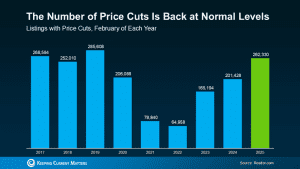
Therefore, price cuts are on the rise. Many realtors, hungry for listings, agree to list their clients’ homes above what the market dictates. These agents do their clients a disservice by showing them the path to price decreases and the stigma attached to price cuts.
This graph from Keeping Current Matters (KCM) shows that price cuts, nationwide, are returning to normal levels prior to the Covid Pandemic.
Sellers must reset expectations.
“If you shoot too high and have to lower your price after the fact, you could actually end up walking away with lower offers than if you’d priced it right from the start,” KCM maintains.
Set a realistic price to attract serious buyers. I’ve always felt it best to slightly underprice a home that over-price it. By doing so, you gain more interest and traffic and create competition between buyers. Homes have an intrinsic propensity to rise to their true market value!
Your agent will help you arrive at a pricing strategy by comparing what similar homes in the area recently sold for, not what they listed for. It’s not what Sellers for the homes, but what the market is willing to pay.
According to KCM: “Unfortunately, some sellers still ignore their agent’s advice and prefer to start high just to see what happens. The hope being maybe they get their full asking price, or they at least have more wiggle room for negotiation. But pricing high usually ends up costing you, and here’s why:
- Buyers may not even look at it. Today’s buyers are more budget-conscious than ever. If they see a home that seems overpriced, they’re likely to skip it completely rather than try to negotiate.
- It could sit on the market for too long. The longer your home sits unsold, the more buyers will assume something’s wrong with it. That can make it even harder to sell down the line.
- You might end up getting less. Homes that require a price cut often sell for less than they would have if they had been priced right from the start.”
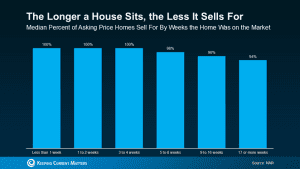
This graph shows that if a house sells within the first 4 weeks it is listed, it usually goes for full price. Based on experience, that’s what usually happens to homes that are priced at, or just below current market value. If it’s priced right, buyers will be interested, and, ultimately, willing to pay the asking price – or compete with other buyers and even go over asking.
A house priced too high doesn’t sell as quickly or at all.